


Properties of the materials being used across manufacturing have fundamentally changed, raising a new set of questions in the realm of materials testing. These stem from “will new physical attributes affect final product performance?” to “how will these new materials perform against proven and relied-upon industry standards?” (Figure 1)
In the face of this uncertainty, materials testing professionals are accessing better research and testing tools as well as standards that are evolving to properly evaluate new material formulations and performance characteristics. Two particularly affected areas are additive manufacturing and recycled and composite polymers, both of which introduce a different set of variables into the processing of materials, which in turn affects materials testing principles.
Additive manufacturing is quickly moving from R&D into mainstream production, bringing with it a new set of materials, processes and performance variables. It’s becoming even more important to understand the molecular structure, thermal properties and post-processing function of these materials. No longer just about the finished product, there are several other manufacturing variables influencing material performance.
Superalloys in aerospace, power generation and other high-temperature applications require elevated temperature testing to ensure material strength and long-term durability as well as identify deformation under real-world operating conditions. (Figure 2)
The standards for evaluating these material characteristics are evolving alongside the technologies. For example, ASTM International’s Committee F42 on Additive Manufacturing Technologies evaluates more than 70 standards that directly impact additive manufacturing to ensure the methods, processes and qualification parameters are inline with this next-generation of materials.
Some key standards the committee oversees include:
Learn more about Committee F42, which is working to establish a testing environment that aligns with the material properties of today’s additive technologies as they become more prevalent in critical manufacturing applications.
Melt flow is another area of materials testing where the old principles are being challenged by newer materials, both from recycled plastics and advanced composite formulations. From resins, fillers and reinforcements to processing history, viscosity and flow behavior, each batch of plastics and polymers requires a careful eye on material properties and physical characteristics. (Figure 3)
Parameters such as resin-to-reinforcement ratio and material formulation strength matter, especially when additives and recycled content are being introduced to raw material or reformulated batches. Materials testing needs to accurately track what a change in resin formulation looks like or if process timing impacts fiber/filler loading as well as historical melt flow rates (MFR) to provide a predictive path for advanced composites and recycled plastics.
One area where melt flow testing is evolving is test equipment. Loadcell-based melt flow indexing (MFI) enables constant load, extremely detailed accuracy and improved observation when testing these new and inventive compositions.
An added benefit of the new digital system is operator safety, since manual weights are no longer required, and the calibration, testing and cleaning processes are all automated, while still being in full compliance with ASTM D1238 and ISO 1133-1.
The common thread across these changes in materials testing is better access to more detailed data. What do all these results mean? How can the industry use these insights to improve processes moving forward? The goal: develop stronger and more consistent batch-to-batch yield.
Software is the layer transforming disparte machine data into a unified library of information used throughout the materials testing process. Not only do comprehensive platforms, like Horizon, improve reporting and analysis, they actually help streamline workflow, aid in research and development as well as increase traceability in manufacturing operations. (Figure 4)
Being able to recognize patterns and processing trends that facilitate informed decisions, for example, is a crucial advantage when working with new formulations, additives and composites. Capturing and organizing test results along with specimen and batch data means easier comparisons and improved continuity. Deeper insights through networked data contribute to trends analysis and anomaly detection. Materials testing intelligence increases, leading to a stronger test environment.
As the search for new, better and more effective compositions continues, materials testing professionals are tasked with staying ahead of the curve, and new formulations will introduce news questions. Both the international standards organizations and test system manufacturers are stepping up to provide an enhanced set of parameters and tools that will ensure compliance and safety as material properties continue to evolve.
Together, these resources forge a solid infrastructure that then incorporates a unified data network for an even more comprehensive and confident test environment. Materials will continue to evolve, but test engineers have the means to evaluate, measure and understand them.
Materials testing is one of the most valuable ways to ensure quality products by providing consistent, measurable results based on industry standards.
From the manufacturing plant and research laboratory to numerous universities and educational institutions, companies use materials testing to ensure product excellence, optimize efficiency, and prevent costly failures. While every sector uses materials testing for different reasons, the goals remain consistent — improve product development and reliability.
An important, yet often overlooked benefit, is cost efficiency. By understanding the properties and behaviors of materials, organizations can make smarter decisions that drive long-term savings and innovation. (Figure 1)

Across all markets, materials testing drives measurable economic and operational efficiencies, offering a powerful return on investment. Some of the most significant benefits include:
A solid materials testing strategy will help in prioritizing and assessing what needs evaluation and when:
The effect is clear. Faster, more efficient testing means better throughput and less waste. With improved capacity, companies can evaluate more materials and design options. The result is informed decisions that provide better insights and lower operating costs.
Automated materials testing is becoming a mainstay, with options ranging from semi-automated to fully autonomous systems. As these systems more deeply embrace data-driven architectures, companies can gain even more cost savings. Integrated software platforms, such as Horizon, provide test control, data collection, analysis, and reporting that improve quality records, enable easier audits, and reduce overall errors. (Figure 2)
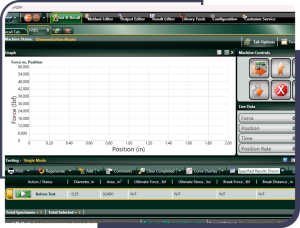
Automated systems can run large volumes of specimens across more tests per day with limited or even no operator intervention or calibration needed in between tests. And test data can flow directly into the software platform.
For manufacturers and third-party testing facilities, materials testing forms the backbone of quality assurance. It ensures that every material used in production meets industry standards, regulations, and specifications.
A robust testing process starts by identifying potential weaknesses in raw materials before they reach the assembly line. This not only improves product performance and safety but also reduces the risks of defects, recalls, and warranty claims—issues that can significantly impact profitability and brand reputation.
But beyond quality control, materials testing helps streamline production efficiency leading to better cost optimization. By understanding how materials respond to factors such as stress, heat, or fatigue, manufacturers can minimize waste and improve throughput. For example, knowing the exact limits of a material’s tensile strength can prevent overuse, saving both time and resources.
Simply put, every dollar invested in testing up front can prevent thousands in lost production costs, warranty issues, or customer frustration later on.
In research labs and universities, materials testing validates the performance of new materials and products—bridging the gap between theory and real-world application.
Insights into a material’s mechanical, thermal, and chemical properties allow scientists to assess potential uses, optimize formulations, and meet specific performance criteria. For instance, researchers developing advanced composites or materials rely on testing data to ensure those materials can withstand the conditions of their intended use.
Materials testing not only verifies what works, but also reveals why something works, leading to faster development cycles and more cost-effective R&D investments. The ability to identify issues early in the design phase reduces trial-and-error experimentation, shortens time to market, and ensures that resources are used efficiently.
In essence, materials testing is the key that unlocks innovation—turning promising concepts into reliable, scalable technologies.
Materials testing is a strategic investment in quality, efficiency, and innovation. Not only can organizations realize substantial cost savings, but they can enhance their competitive edge. Whether ensuring the reliability of manufactured goods, validating breakthrough technologies in research, or driving discovery within universities, this critical testing infrastructure provides the foundation to support progress and improve cost efficiencies.
Ready to optimize your materials testing process to save time and money? Check out The Many Roles of Automated Material Testing (AMT) in Manufacturing white paper for more insights.
Automation, long a fixture of the production floor, has made its way into the materials testing environment across virtually all manufacturing sectors, from automotive and aerospace to medical devices and advanced polymers.
Materials testing equipment is no longer just a set of passive machines. Instead, the testing landscape is transforming into one where intelligent, integrated systems not only manage the testing process, but form a network that influences manufacturing operations and production efficiencies in near real time.
In addition to verifying materials’ performance and ensuring safety specifications, automated testing provides new means for innovative materials research as well as optimum production environments. The impact reaches well beyond simple data analysis and efficiency gains. Automation is the fundamental step for teeing up a materials testing environment to embrace an AI-enabled ecosystem. (Figure 1)

In today’s manufacturing environments, you’d be hard pressed to find a company without a plan that includes some degree of AI implementation. Although materials testing has traditionally sat a bit apart from the manufacturing environment, today’s digitally-based equipment and advanced data sets are quickly becoming a streamlined part of facility operations.
But technology adoption should happen at the rate that makes sense for your test environment. A great place to start is to take stock of the available technologies and existing processes and see where you can make immediate improvements in your process versus planning for some more long-term investments.
Here we examine some trending technology shifts fueling automation adoption throughout materials testing:
Closed-loop control. Not new, but expanding, closed loop control allows for continuous monitoring and real-time load adjustment. Systems using digital technologies can respond dynamically to how a material truly behaves rather than simply applying force at a fixed rate, for example. A recent implementation is the loadcell-based MP1500 that eliminates the need for a deadweight system in melt flow indexing and incorporates a closed-loop control system. (Figure 2)
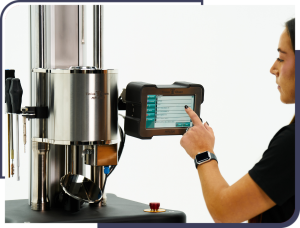
Extensometry. Contactless extensometry is making strides. One example is the UVX3D that not only removes the awkward useability issues of traditional units but offers elevated or enhanced technical performance that supersedes single-camera units. This extensometer captures a video stream and replays it with the digital strain data embedded for analysis and use, essentially allowing the user to replay the test.
A new class of extensometry is also emerging with the Vector, which serves as a cost-effective replacement for virtually any clip-on type of extensometer currently available. Its underlying AI-based technology has initiated a game-changing shift by turning the testing machine zone into a digital representation. Test events can easily be measured across large, small and even non-uniform specimens, with a simple, no-touch set up.
Integrated software. Highly sophisticated software platforms are not just observing what test machines are doing, but are helping to direct the process, serving as an extension of the test environment itself. The functionality goes far beyond simple data collection to include automation control, data management, and reporting capabilities that provide faster, deeper insights into material characteristics. These advanced software platforms are facilitating large-scale integration across system processes and providing easy access to more comprehensive and intuitive analysis.
Take the Horizon platform that exemplifies this forward-looking strategy to elevate the materials testing digital landscape. Instead of requiring a full system overall, the software is structured in modules that allow users to implement technology upgrades where and when it makes sense, and only for the test and results needed. This inherent flexibility is the cornerstone of an automated testing environment, as it enables labs and manufacturing facilities to keep pace with technology advancements without sacrificing standardization or operational efficiency. (Figure 3)
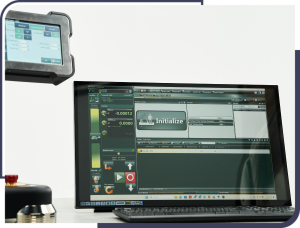
Multi-machine Systems. Some may consider this more of an outcropping of software technology advancements, but systems that run multiple machines simultaneously are being built, needing just one operator to oversee what used to be several, disparate test stations. As digital tools and technologies continue to fuse, a more networked infrastructure is becoming the norm, with a look towards multi-faceted test environments that are more integrated, optimized and cost-efficient.
Tinius Olsen offers a scalable, modular method of technology insertion that helps customers in their path to automation, on a timeline and within a budget that makes sense. This approach ensures that updates and investments keep pace with the test environment, whether it includes tensile, compression, flexural, impact, melt flow, hardness tests or another testing protocol.
Whether the goal is to determine the tensile strength of a structural alloy, characterize the flexural behavior of a fiber-reinforced composite, or evaluate the melt flow properties of a new batch of resin, materials testing is not a trivial process. Every test is governed by strict international standards that specify not just what to measure, but exactly how.
ASTM, ISO and other governing standards organizations remain essential to ensure consistent, repeatable and comparable results across different test environments and regions. Automation serves to facilitate the process and optimize the data, but standards provide the framework for reliable, universally repeatable results. Any automated testing platform needs to stay aligned with industry protocols, so that the measurement ecosystem, which includes calibration methods, sample handling, data analysis, test environments, and more, still follows these critical standardized methods.
Automation is not simply about speed. It is about optimization, efficiency and integration. What was once a largely passive, machine-based process is evolving into an intelligent, interconnected ecosystem that influences manufacturing operations in near real time. Taking stock of trends today will prepare you for the materials testing environment you want tomorrow.
To learn more about what else is happening in the automated materials testing environment, download The Many Roles of Automated Material Testing (AMT) in Manufacturing white paper.
Please read these terms and conditions carefully before using Our Service.
The words whose initial letters are capitalized have meanings defined under the following conditions. The following definitions shall have the same meaning regardless of whether they appear in singular or in plural.
For the purposes of these Terms and Conditions:
These are the Terms and Conditions governing the use of this Service and the agreement between You and the Company. These Terms and Conditions set out the rights and obligations of all users regarding the use of the Service.
Your access to and use of the Service is conditioned on Your acceptance of and compliance with these Terms and Conditions. These Terms and Conditions apply to all visitors, users and others who access or use the Service.
By accessing or using the Service You agree to be bound by these Terms and Conditions. If You disagree with any part of these Terms and Conditions then You may not access the Service.
You represent that you are over the age of 18. The Company does not permit those under 18 to use the Service.
Your access to and use of the Service is also subject to Our Privacy Policy, which describes how We collect, use, and disclose personal information. Please read Our Privacy Policy carefully before using Our Service.
The Service and its original content (excluding Content provided by You or other users), features and functionality are and will remain the exclusive property of the Company and its licensors.
The Service is protected by copyright, trademark, and other laws of both the Country and foreign countries.
Our trademarks and trade dress may not be used in connection with any product or service without the prior written consent of the Company.
Our Service may contain links to third-party websites or services that are not owned or controlled by the Company.
The Company has no control over, and assumes no responsibility for, the content, privacy policies, or practices of any third-party websites or services. You further acknowledge and agree that the Company shall not be responsible or liable, directly or indirectly, for any damage or loss caused or alleged to be caused by or in connection with the use of or reliance on any such content, goods or services available on or through any such websites or services.
We strongly advise You to read the terms and conditions and privacy policies of any third-party websites or services that You visit.
The Service may display, include, make available, or link to content or services provided by a Third-Party Social Media Service. A Third-Party Social Media Service is not owned or controlled by the Company, and the Company does not endorse or assume responsibility for any Third-Party Social Media Service.
You acknowledge and agree that the Company shall not be responsible or liable, directly or indirectly, for any damage or loss caused or alleged to be caused by or in connection with Your access to or use of any Third-Party Social Media Service, including any content, goods, or services made available through them. Your use of any Third-Party Social Media Service is governed by that Third-Party Social Media Service’s terms and privacy policies.
We may terminate or suspend Your access immediately, without prior notice or liability, for any reason whatsoever, including without limitation if You breach these Terms and Conditions.
Upon termination, Your right to use the Service will cease immediately.
Notwithstanding any damages that You might incur, the entire liability of the Company and any of its suppliers under any provision of these Terms and Your exclusive remedy for all of the foregoing shall be limited to the amount actually paid by You through the Service or 100 USD if You haven’t purchased anything through the Service.
To the maximum extent permitted by applicable law, in no event shall the Company or its suppliers be liable for any special, incidental, indirect, or consequential damages whatsoever (including, but not limited to, damages for loss of profits, loss of data or other information, for business interruption, for personal injury, loss of privacy arising out of or in any way related to the use of or inability to use the Service, third-party software and/or third-party hardware used with the Service, or otherwise in connection with any provision of these Terms), even if the Company or any supplier has been advised of the possibility of such damages and even if the remedy fails of its essential purpose.
Some states do not allow the exclusion of implied warranties or limitation of liability for incidental or consequential damages, which means that some of the above limitations may not apply. In these states, each party’s liability will be limited to the greatest extent permitted by law.
The Service is provided to You “AS IS” and “AS AVAILABLE” and with all faults and defects without warranty of any kind. To the maximum extent permitted under applicable law, the Company, on its own behalf and on behalf of its Affiliates and its and their respective licensors and service providers, expressly disclaims all warranties, whether express, implied, statutory or otherwise, with respect to the Service, including all implied warranties of merchantability, fitness for a particular purpose, title and non-infringement, and warranties that may arise out of course of dealing, course of performance, usage or trade practice. Without limitation to the foregoing, the Company provides no warranty or undertaking, and makes no representation of any kind that the Service will meet Your requirements, achieve any intended results, be compatible or work with any other software, applications, systems or services, operate without interruption, meet any performance or reliability standards or be error free or that any errors or defects can or will be corrected.
Without limiting the foregoing, neither the Company nor any of the company’s provider makes any representation or warranty of any kind, express or implied: (i) as to the operation or availability of the Service, or the information, content, and materials or products included thereon; (ii) that the Service will be uninterrupted or error-free; (iii) as to the accuracy, reliability, or currency of any information or content provided through the Service; or (iv) that the Service, its servers, the content, or e-mails sent from or on behalf of the Company are free of viruses, scripts, trojan horses, worms, malware, timebombs or other harmful components.
Some jurisdictions do not allow the exclusion of certain types of warranties or limitations on applicable statutory rights of a consumer, so some or all of the above exclusions and limitations may not apply to You. But in such a case the exclusions and limitations set forth in this section shall be applied to the greatest extent enforceable under applicable law.
The laws of the Country, excluding its conflicts of law rules, shall govern these Terms and Your use of the Service. Your use of the Application may also be subject to other local, state, national, or international laws.
If You have any concern or dispute about the Service, You agree to first try to resolve the dispute informally by contacting the Company.
If You are a European Union consumer, you will benefit from any mandatory provisions of the law of the country in which You are resident.
You represent and warrant that (i) You are not located in a country that is subject to the United States government embargo, or that has been designated by the United States government as a “terrorist supporting” country, and (ii) You are not listed on any United States government list of prohibited or restricted parties.
If any provision of these Terms is held to be unenforceable or invalid, such provision will be changed and interpreted to accomplish the objectives of such provision to the greatest extent possible under applicable law and the remaining provisions will continue in full force and effect.
Except as provided herein, the failure to exercise a right or to require performance of an obligation under these Terms shall not affect a party’s ability to exercise such right or require such performance at any time thereafter nor shall the waiver of a breach constitute a waiver of any subsequent breach.
These Terms and Conditions may have been translated if We have made them available to You on our Service. You agree that the original English text shall prevail in the case of a dispute.
We reserve the right, at Our sole discretion, to modify or replace these Terms at any time. If a revision is material We will make reasonable efforts to provide at least 30 days’ notice prior to any new terms taking effect. What constitutes a material change will be determined at Our sole discretion.
By continuing to access or use Our Service after those revisions become effective, You agree to be bound by the revised terms. If You do not agree to the new terms, in whole or in part, please stop using the Service.
If you have any questions about these Terms and Conditions, You can contact us: